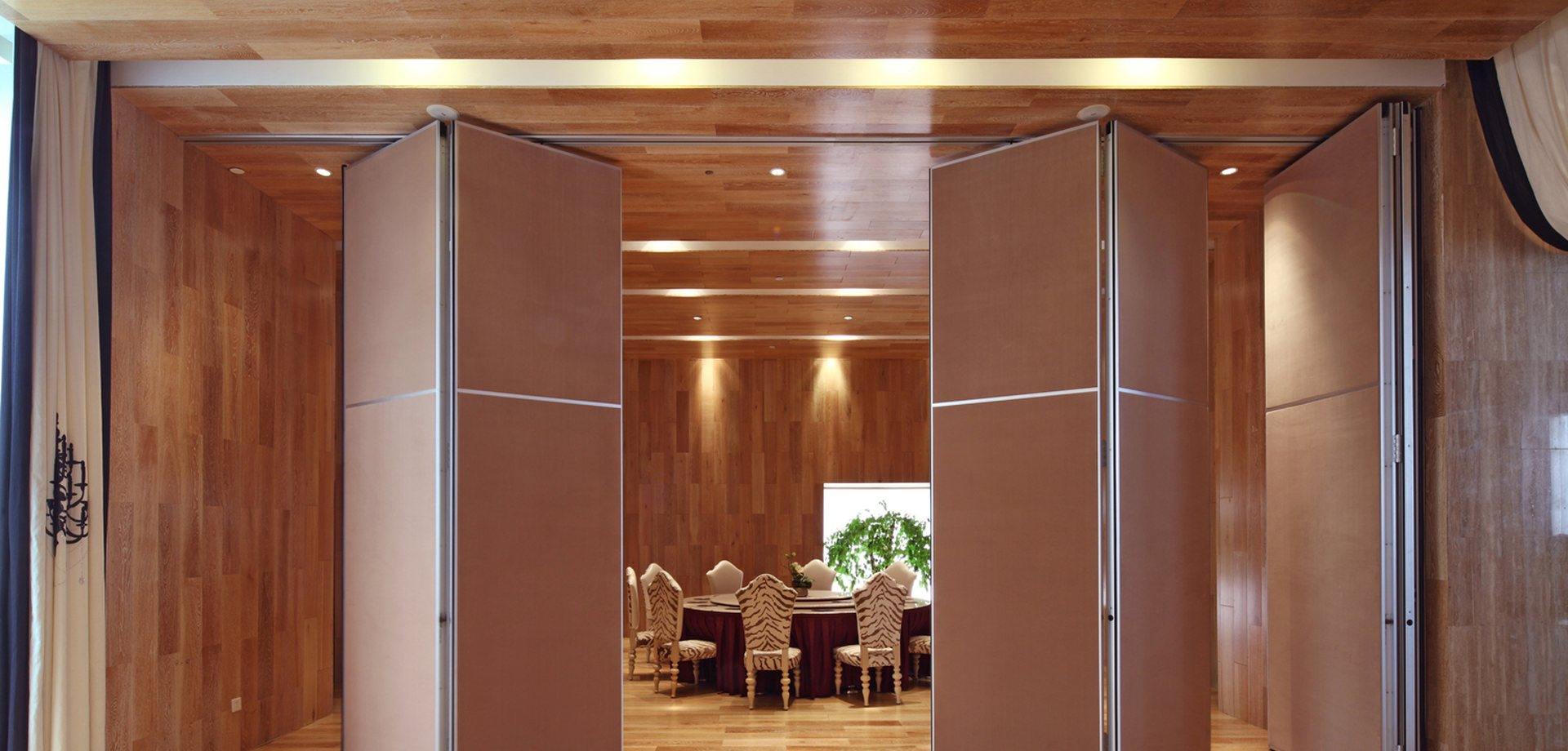
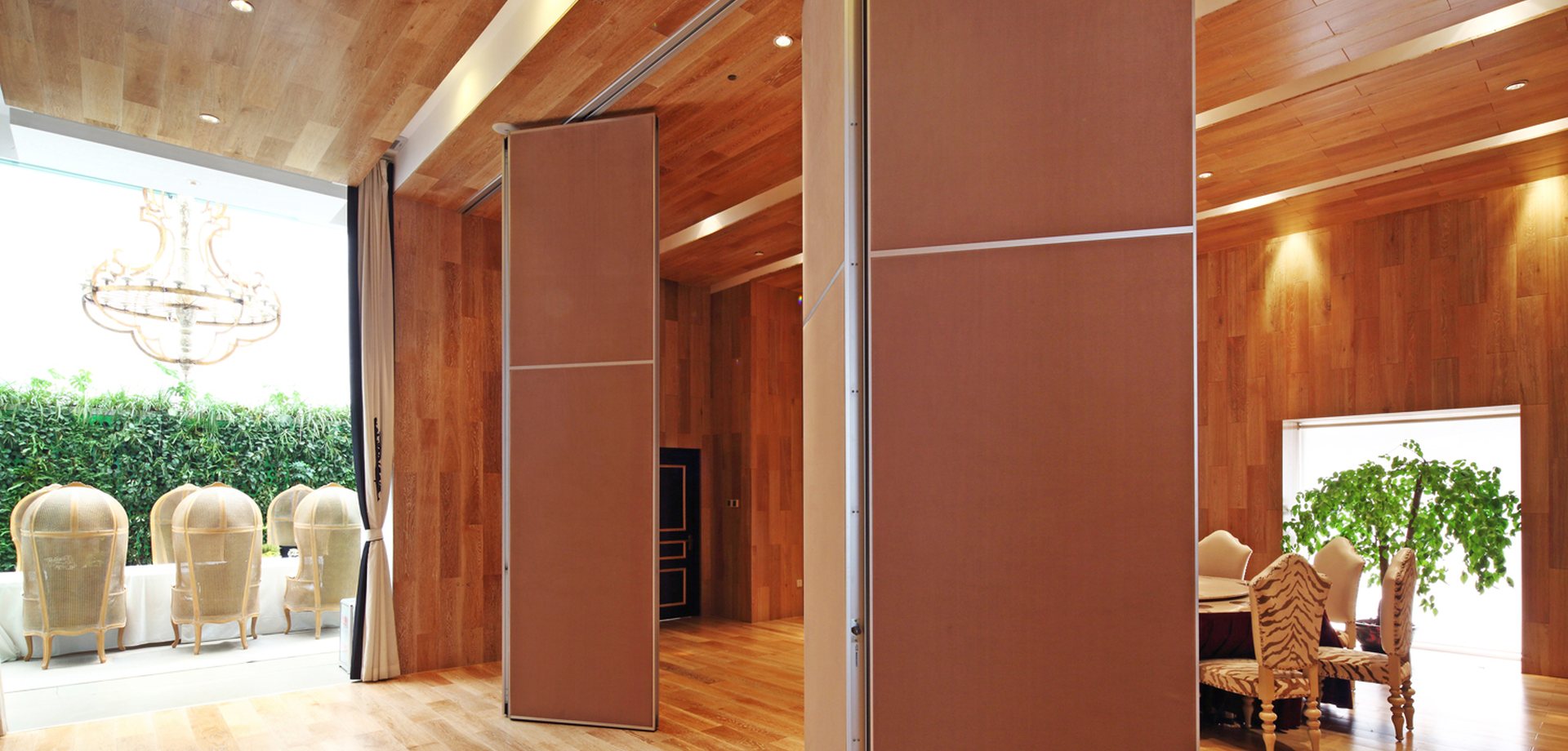
Models NW831 · NW840 · NW840-W — Two panels hinged at the meeting stile, folded back on each other
Paired Hinged & Folding Operable Partitions
A paired hinged partition is an operable wall in which panels are joined in pairs by a hinge at the meeting stile. The pair folds back on itself, runs on the same overhead track as a single panel system, and is handled as one unit. Two consequences follow, and they are the whole argument for the system: the operator closes a given opening in roughly half the moves, and when the run is open each pair occupies the depth of a single panel rather than two, so the stack is shorter.
80 / 100 / 92-96 mm
Panel Thickness
4 000 / 6 000 mm
Max Height
38-52 kg/m²
Panel Weight
Rw 40-55 dB
Acoustic (ISO 717-1)
Product Overview
A paired hinged partition is an operable wall in which panels are joined in pairs by a hinge at the meeting stile. The pair folds back on itself, runs on the same overhead track as a single panel system, and is handled as one unit. Two consequences follow, and they are the whole argument for the system: the operator closes a given opening in roughly half the moves, and when the run is open each pair occupies the depth of a single panel rather than two, so the stack is shorter.
Key Features
The same three build-ups as the single panel system - 80 mm, 100 mm, and steel-framed 92 / 96 mm
Panels 600-1 200 mm wide, hinged in pairs; the pair travels and turns as one unit
Top hung, no floor guide, manual lever seals on all three models
Stacks into a recess, a pocket or against a wall return
How It Operates
1
Release both panels
The operating lever on each panel retracts its top and bottom seals. On a pair both levers are set before the pair is moved, because the panels travel together.
2
Fold the pair
The hinge at the meeting stile lets the pair fold back on itself. Folded, the two panels sit face to face and the pair occupies the depth of one panel in the stack.
3
Run the pair to the opening
The folded pair is rolled along the overhead track. One movement carries two panels, which is where the time saving comes from on a long run.
4
Open the pair out
At the closing line the pair swings open and the two panels land against the previous pair and the jamb.
5
Set the seals
Each panel lever is turned again to extend the top pressure seal and the bottom pressure bar. The hinge line itself is closed by the joint seal, not by the hinge.
Technical Specifications
Panel configuration
Paired hinged panels
Panel thickness
3-1/8 / 3-15/16 / 3-5/8-3-3/4 in
Max panel height
13 ft 1 in / 19 ft 8 in
Panel width
23-5/8 - 47-1/4 in
Panel suspension
Top hung only
Track system
Single or twin point
Frame construction
Aluminium / Steel
Vertical edge
Aluminium profile / Trimless or trimmed
Seal operation
Manual / Manual + optional
Operation mechanism
Push-to-Extend / Jack-type
Acoustic - Rw
Rw 40-55 dB (ISO 717-1)
Panel weight
7.8-8.2 / 8.2-9.2 / 9.8-10.6 psf
Pass doors
Single or double door
Warranty
2 years panels; 5 years track
Test values apply to the specimen described above, tested at a 4 000 × 2 500 mm opening. Sound insulation in the finished installation depends on the surrounding structure, the head detail and the sealing of the perimeter.
Technical Details · Paired Hinged
Construction Details - Paired Hinged Partitions
A paired run is built from the same panels as a single panel run, joined at the meeting stile. The drawings below show the panel that is being paired, how the hinge line closes, how the pair is carried, and how it parks.
Click to enlarge
Pair Geometry
Two Panels, One Hinge Line
The hinge is at the meeting stile, not on the face, so the pair closes into the same joint as two single panels when it is opened out.
Each panel carries its own seals and its own lever. The pair is two complete panels joined, not one panel split.
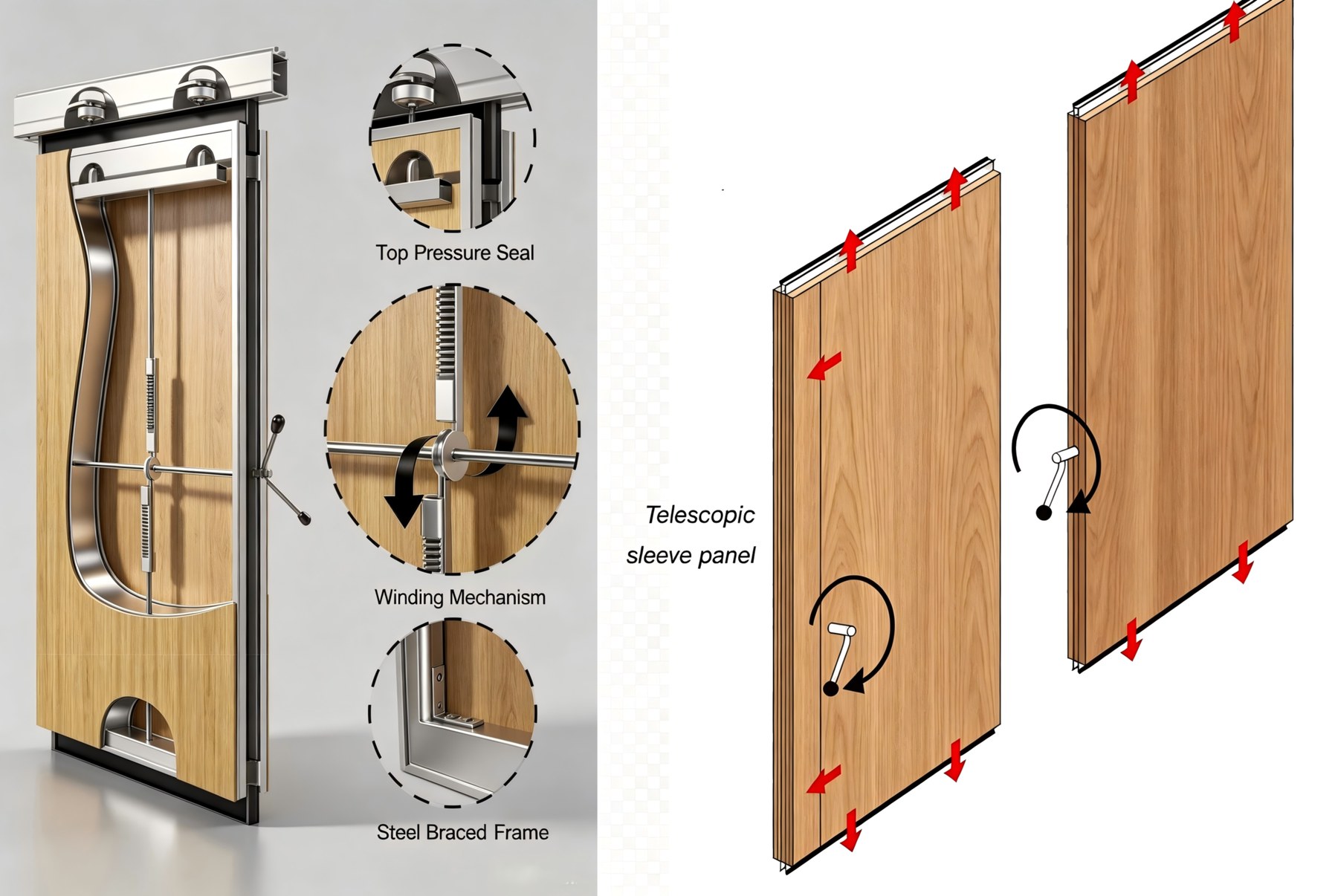
The frame takes the fold cycle. The braced frame keeps each panel square so the seal lands where it was set, however many times the pair is folded.
Click to enlarge
Joint
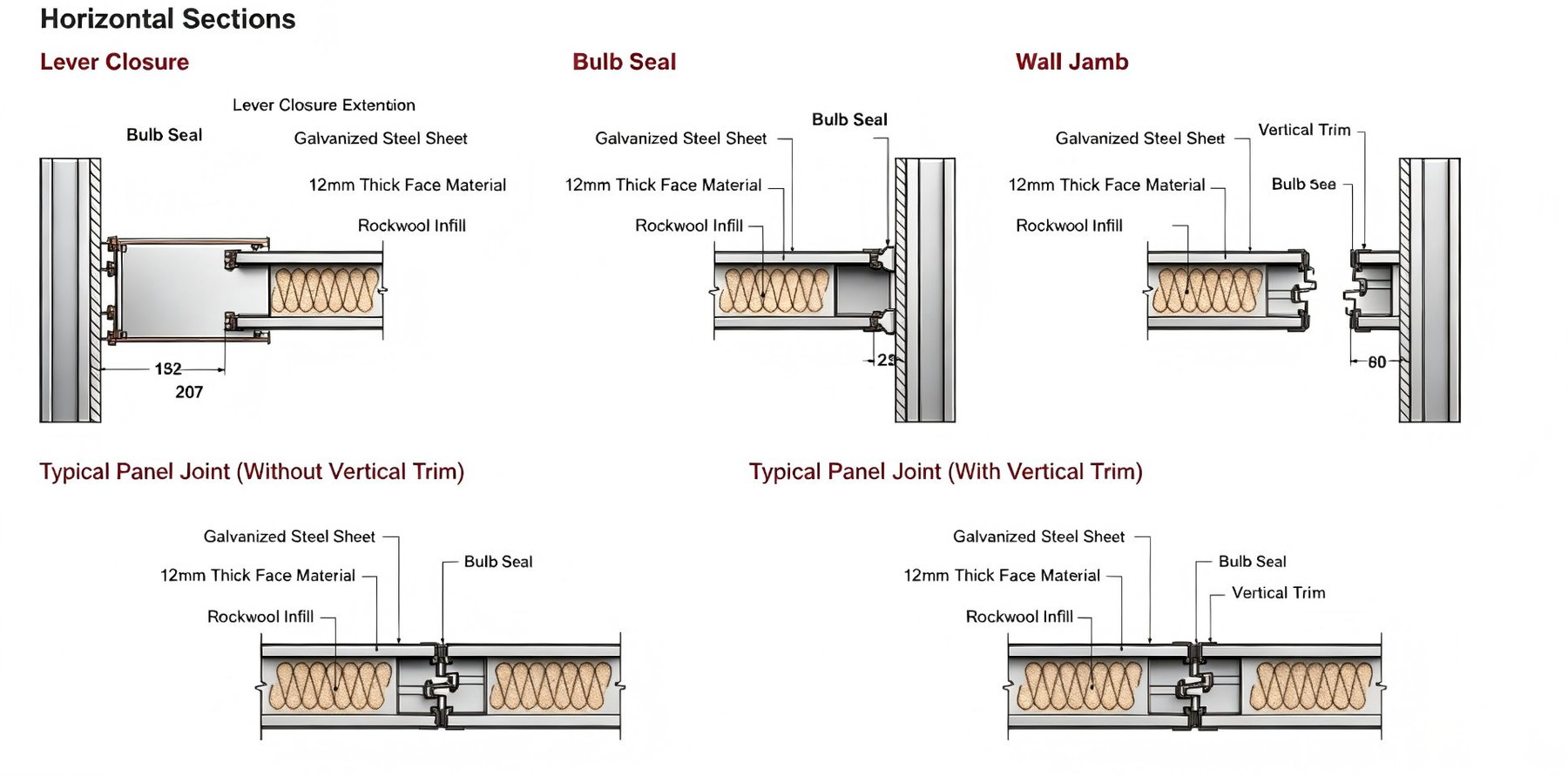
Horizontal Section Through the Joint
The hinge line closes like a joint, with the same bulb and finger seals as a panel-to-panel joint. Sealing is not delegated to the hinge.
Wall jamb - a full-length bulb seal at the jamb takes up the building tolerance on the first pair.
Trimmed or trimless - both edges are available on NW840 and NW840-W, and the choice applies to the hinge stile as well.
Shown as typical - hinge and jamb detailing is confirmed on the shop drawing.
Click to enlarge
Suspension
Twin Point Carriers Take the Pair
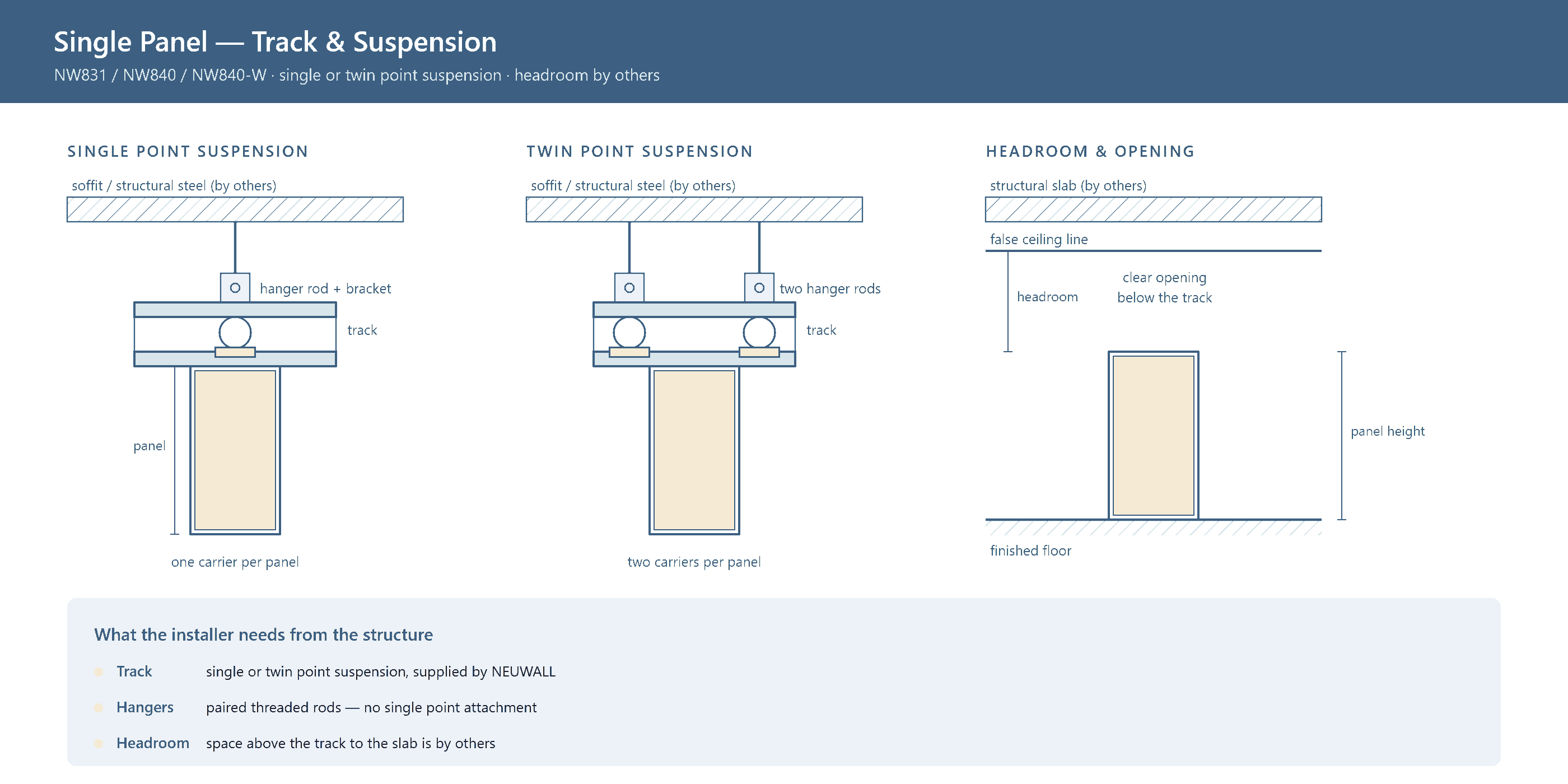
Twin point is the usual arrangement for a pair: two carriers per panel spread the load and hold the panel against twist as it folds.
Single point remains available on the lighter build-ups and shorter panels.
Headroom above the track to the structural slab is by others, set from the finished floor line.
Click to enlarge
Parking
Single Roller Stacking
Six standard arrangements for a single roller set, in plan against a wall return or a recess.
Hinged pass door at the stack end keeps the opening usable while the wall is parked - the arrangement most often specified for a divisible suite.
Stacking and operating areas are given for reference only and are confirmed per project.
Click to enlarge
Parking
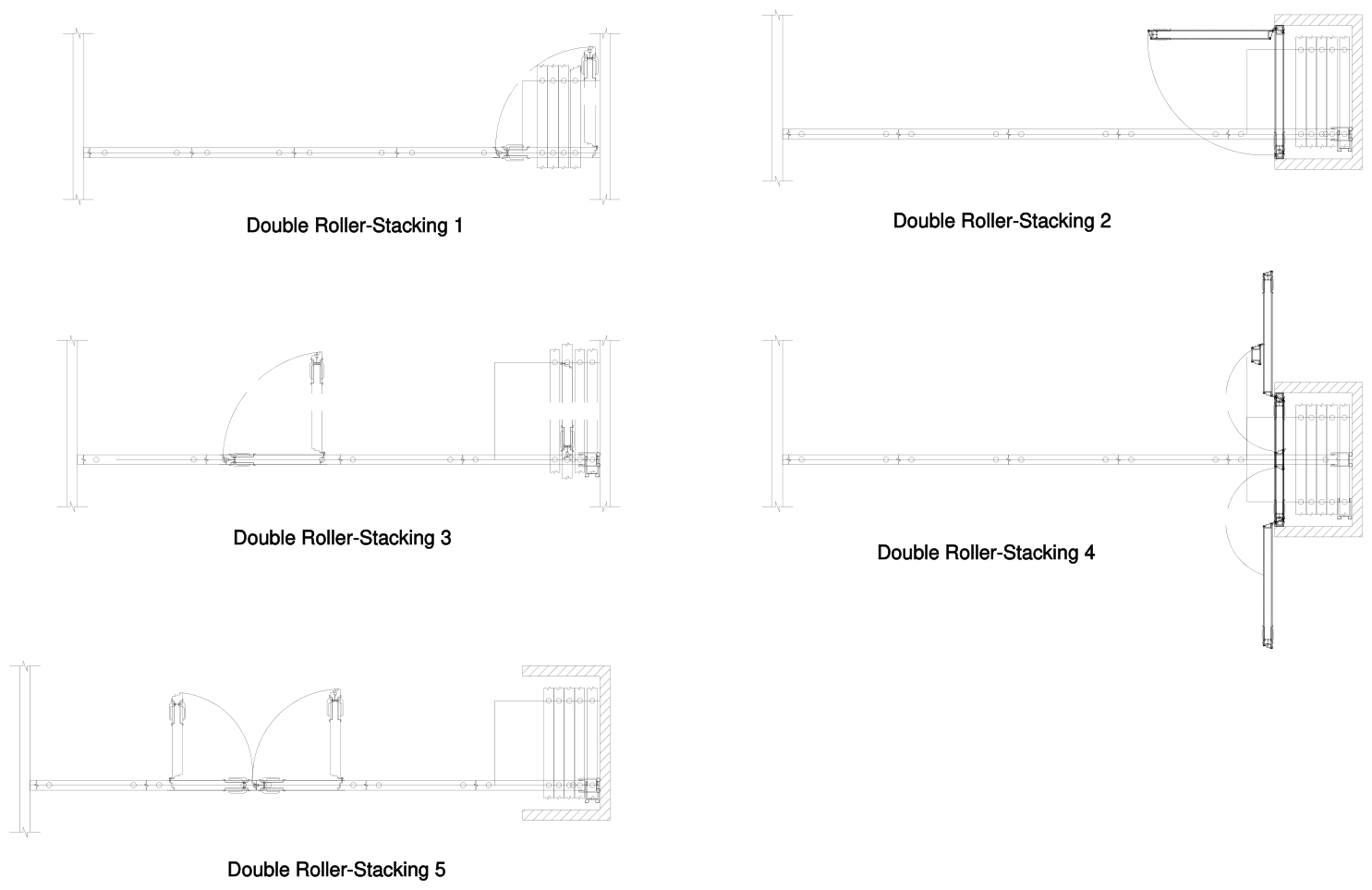
Double Roller Stacking
The double roller set carries a heavier pair, or a pair at greater height, over two carriers per panel.
Specified when the pair weight or height is beyond what a single carrier is set for.
The steel track version of this arrangement is on the Tall Openings page.
Click to enlarge
Pass Doors
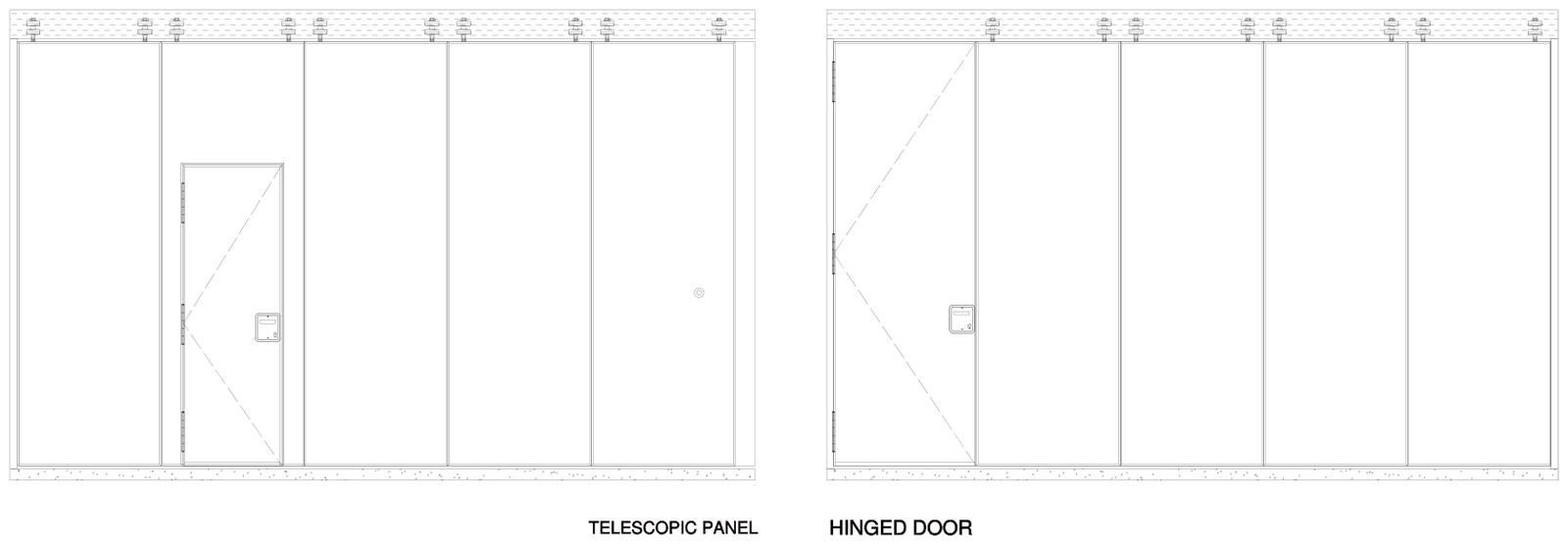
Telescopic Panel and Hinged Door
Telescopic panel - a narrow leaf that draws out of the stack to close the last gap, so a door is formed without a full panel width of stacking space. This matters more on a paired run, where the stack is fixed by the number of pairs.
Hinged door - a full-height leaf within the run, for a normal single-leaf opening.
Pass door type is fixed on the shop drawing, because it changes the stacking length.
Verified data
Value
Models
NW831 · NW840 · NW840-W
Configuration
Paired hinged panels - single panel also available on the same model
Panel thickness
NW831 80 mm · NW840 100 mm · NW840-W 92 mm trimless / 96 mm trimmed
Manual on all three · semi-auto and fully-auto on NW840-W only
Hinge
At the meeting stile; each panel keeps its own seals and its own lever
Note on acoustic data: the figures quoted as Rw are laboratory airborne sound insulation ratings for the panel build-up (ISO 717-1). Rw and STC are not interchangeable and are never converted into one another. STC appears in this range only where an ASTM E90 / ASTM E413 report exists, and the one report on file (XMIN180500970CCM) is for a specimen of 52.4 kg/m², which matches the NW840-W weight band more closely than any other model. The report has not yet been matched to a part number, so it is marked △ and must not be quoted as a model rating until that match is confirmed.
How the Pair Travels and Parks
A pair folds back on itself, so the stack is a set of folded pairs rather than a row of panels. The arrangement is chosen on the space available at the end of the run, and on whether a pass door has to stay usable while the wall is parked.
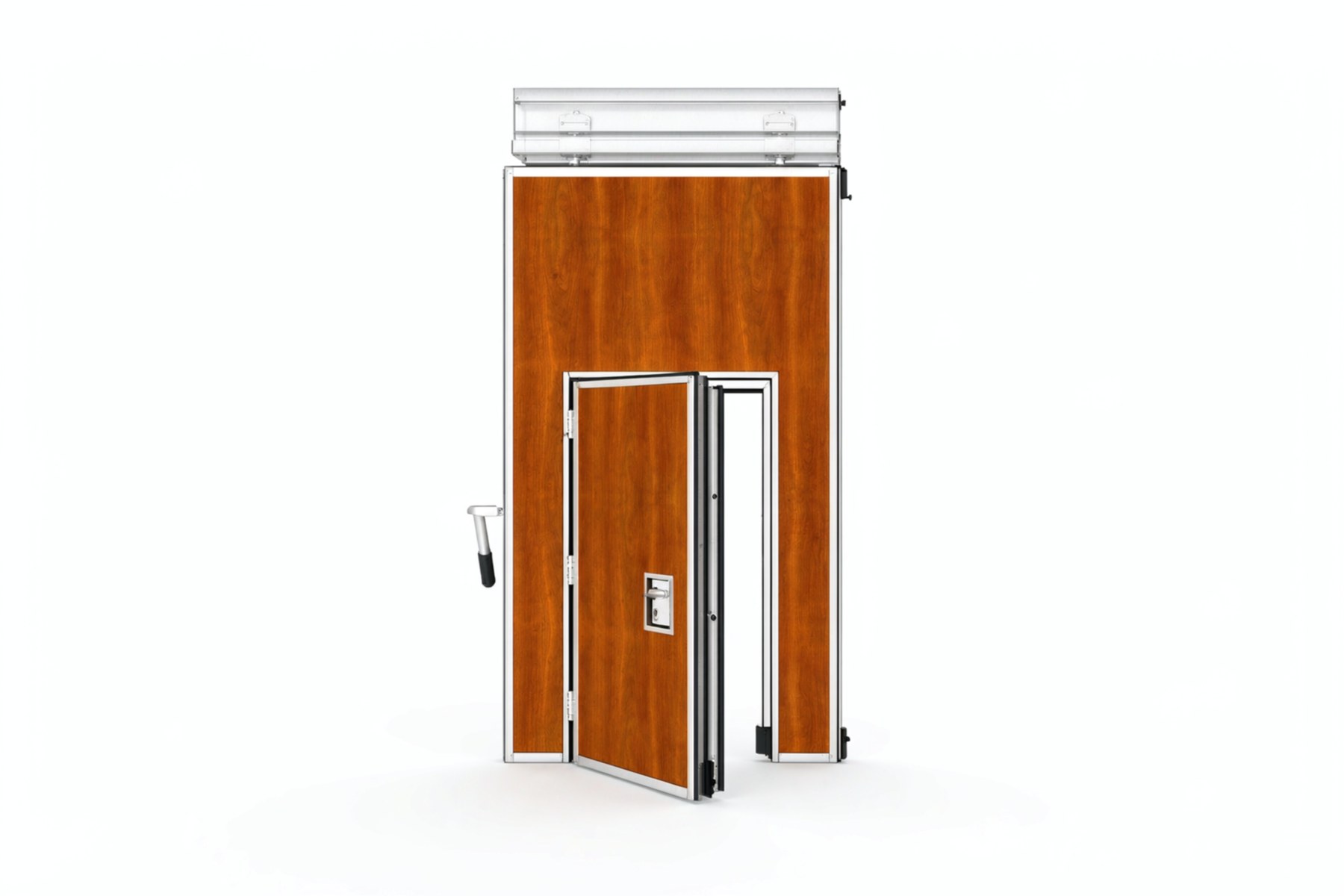
Folded pairs at the stack. Each pair stands face to face, so the stack depth is one panel rather than two. This is on a live project at handover - the finish is still to be cleaned down.Which arrangements accept a pair. The NEUWALL stacking chart marks each type with the roller set it uses and whether it is single panel only. A pair needs a wider turning envelope than a single panel, which is what rules some arrangements out.The pass door. A door set in the panel, below the track, with a lever on both sides and a perimeter seal that closes with the leaf. It is an option on all three models, and the leaf type is fixed on the shop drawing because it decides how much stacking space the run needs.
Space is the constraint, not the panel. Two pairs of 1 200 mm panels need a deeper turning envelope than four single panels of the same width. Give us the opening and the wall return, and the stacking arrangement is set on the shop drawing before the track is ordered.
Compare All Systems
System
Thickness
Max Height
Acoustic
Frame
NW831 Single Panel
80 mm
4 000 mm
Rw 40 / 43 / 45 dB
Aluminium
NW840 Folding
100 mm
6 000 mm
Rw 45 / 48 / 50 dB
Aluminium
NW840-W Motorized
92 or 96 mm
6 000 mm
Rw 50 / 53 / 55 dB
Steel
NW840-W Ultra-High
92 or 96 mm
18 000 mm
Rw 50 / 53 / 55 dB
Steel
NG80 / NG88 Glass Wall
80 / 88 mm
4 000 mm
Rw 44 dB (ISO 717-1)
Aluminium
Downloads & Finishes
Technical documents for this system, the finish colour cards and the available options. Ask us for the shop drawing set for your opening — every quotation is issued with one.
Every file linked above is the actual document — download it, pick a code and send the code with your enquiry. Where a finish has no card linked, the range is available on request.
Options
Pass door
Single or double door set within the panel, with lever handles and perimeter seals. Optional lock.
Pocket door
Sliding leaf parks inside a wall-side pocket, so no leaf remains in the opening when it is open.
Inset writing surface
Markerboard, projection and writing surfaces, tackboards and recessed eraser pockets.
Vision panel
Inset glazing for sightlines into the closed room.
Fire-rated build-up
HPL, vinyl and MDF core options carry separate fire classifications — see the specification table.
Trimless or trimmed edge
NW840 and NW840-W take a flush trimless joint or a profiled aluminium trim. NW831 uses an aluminium profile with a sealing strip, and does not take either edge.
Recommended Applications
Ballrooms and function suites
Divisible meeting rooms
Training and education suites
Banquet and catering spaces
Hotel function rooms
Conference centers
Installation & Support Requirements
Structure for the track is by others. The track is carried by a structural beam or slab above the ceiling. The load and the fixing detail are issued on the shop drawing, and the beam is designed by others to that figure.
The stack is measured on the drawing. A pair is deeper than a single panel folded, and it needs a turning envelope at a corner. The recess is sized for the pair, not for the panel, and that is settled before the wall is built.
No floor guide. The system is top hung, so nothing is fixed to the finished floor and no channel is cut into it.
Track height is set from the finished floor. The rail is hung after the floor is complete and surveyed, and the headroom above it is by others.
Seal access is planned. Every panel in a pair carries its own lever, and the levers have to be reachable when the pair is in the stack - which is the detail most often missed when a recess is sized.
Shop drawings are issued before fabrication. They set out the run, the fold direction, the stacking and the beam interface, and they are the document the installer works to.
Warranty
2 Years
Panel Warranty
Against defects in materials and workmanship, effective from the date of substantial completion.
5 Years
Track & Trolley Warranty
Against defects in materials and workmanship, effective from the date of substantial completion.
When should I specify paired hinged rather than single panel?
When the opening is wide and is closed and reopened often. A pair halves the number of moves an operator makes, and the stack is more compact because each pair folds back on itself. Single panel is the better choice when panels have to be left anywhere along the run, when the run curves, or when the opening is short.
Can a pair turn a corner?
A pair turns at a corner on the same track as a single panel, but it needs a wider turning envelope, because the folded pair sweeps a larger radius than a single panel. Whether a given corner works is settled on the shop drawing against the wall return and the stacking space - not from a catalogue figure.
Can I mix paired and single panels in one run?
In principle the track and the panels are the same system, and mixed runs exist. Whether it is the right answer for your opening depends on how the run is stacked and how the operator works it. Send us the layout and we will tell you what we would quote rather than leave you to guess.
How does the hinge line stay acoustically sealed?
The hinge is a mechanical joint; the acoustic seal is separate. Each panel carries its own vertical seal at the meeting stile, so when the pair is opened out the hinge line closes through the same bulb and finger seals as a panel-to-panel joint. Sealing is not delegated to the hinge.
Which models can be supplied paired?
All three - NW831, NW840 and NW840-W. Pairing is a configuration, not a model attribute, and none of the three is restricted to single panels.
How are the seals operated on a pair?
By hand, on all three models. NW831 and NW840 are manual only, using the supplied operating lever. NW840-W takes a manual handle as standard and is the only model that can be supplied with semi-automatic or fully automatic seals.
Request a Quote
Contact us with your opening size and acoustic requirement for a quote within 12 working hours.